 Bedrock
Bedrock grants veBR voting power in exchange for locking BR
Bedrock gives locked BR governance weight through veBR, its non-transferable vote-escrowed representation. Keeping BR outside that escrow preserves its transferability. Locking commits the selected tokens to a minimum holding period and a separate exit cooldown, while voting eligibility follows the governance calendar. The choice concerns access as well as influence: a larger or older stake can carry more voting weight, yet that weight cannot be spent as BR. Available rewards follow their own allocation and claim rules.
Bottom line: A BR position can qualify for governance voting before it becomes eligible to enter the exit queue.
BR Balances and veBR Positions
BR held in a wallet remains transferable, while BR committed to governance escrow is represented by a veBR position. Escrow holds the underlying tokens under withdrawal conditions. The position records the commitment that gives its holder voting power. A staking balance and a wallet balance therefore describe different access to the same underlying asset; adding them together does not make all those tokens available for a transfer.
The governance arrangement belongs to the protocol's Proof of Staking Liquidity model. uniETH and uniBTC belong to its asset staking and restaking products, with their own backing and redemption mechanisms. Their liquidity features do not determine whether the BR in a governance position can leave escrow.
A Smaller Stake With BR Kept Available
Staking a selected portion of an available BR balance preserves access to the tokens that remain outside governance escrow. The staking interface accepts a BR amount, subject to the deployment's minimum deposit. This makes the initial commitment adjustable without requiring a holder to lock the entire wallet balance. A deposit below that minimum cannot create a veBR position.
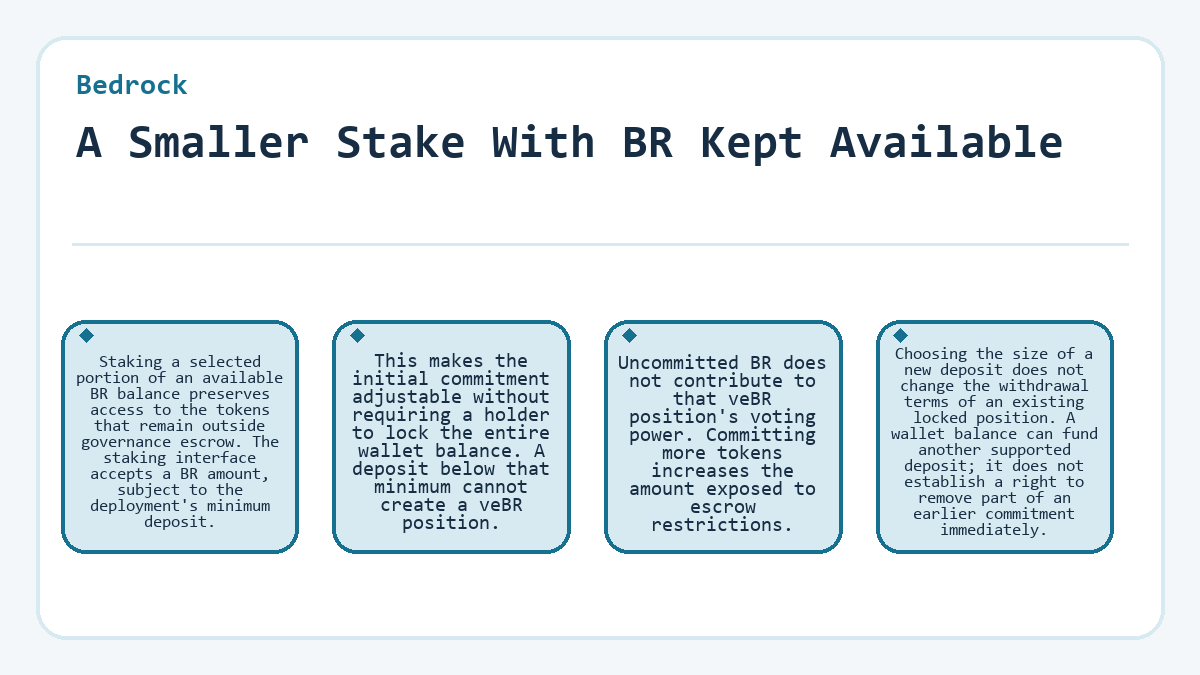
Uncommitted BR does not contribute to that veBR position's voting power. Committing more tokens increases the amount exposed to escrow restrictions. Choosing the size of a new deposit does not change the withdrawal terms of an existing locked position. A wallet balance can fund another supported deposit; it does not establish a right to remove part of an earlier commitment immediately.
Token Amounts and Time-Based Voting Weight
Voting weight reflects committed BR and the time-based curve that the governance implementation applies to the position. The voting power of a veBR position increases with staking duration under the configured increasing-power model, up to the curve's maximum. This growth describes influence in governance. It does not establish that more transferable BR has appeared in the wallet.
The BR amount, the position's age and its voting multiplier answer different questions. The amount identifies committed principal. Age helps determine weight under the active curve, and the multiplier expresses weight relative to that amount. These values belong to a position with a recorded start. An advertised maximum multiplier does not establish the weight of a newly created stake, nor does it set a market exchange rate between veBR and BR.
Gauges and the Limits of a Vote
A gauge vote directs the distribution of incentive emissions among the approved options available in the governance system. Gauges connect voting weight to pools or initiatives that receive allocations. Their available choices determine what a vote can influence; owning veBR does not create unrestricted authority over the protocol.
A gauge's reward recipient can differ from the voter. A pool allocation does not establish a personal claimable reward balance.
Other governance proposals can concern protocol settings, upgrades or treasury decisions within their defined scope. Eligibility thresholds and the proposal's stated actions govern those rights. Influence over an emissions choice does not automatically provide authority to change every contract setting or access treasury assets.
Gauge voting records allocation preferences without executing a treasury transfer or contract upgrade. Those actions require their own authorized governance and execution mechanism.
Voting Windows and Warmup
Voting requires an eligible veBR position and an open voting window, so a confirmed stake need not be immediately usable in a vote. The warmup requirement concerns eligibility after a deposit. The epoch calendar separately determines when the system accepts votes.
The governance cycle separates voting from reward distribution and claims. Staking age can continue to matter between voting windows, but it does not turn a distribution phase into a voting phase. A holder seeking influence over a particular allocation needs the position to qualify within that allocation's active voting window. The applicable clock and position status determine that timing, rather than a universal wait measured from a wallet signature.
Exit Eligibility and the Withdrawal Queue
A minimum holding period controls entry into the exit queue, and a separate cooldown controls when an accepted exit becomes withdrawable. These restrictions govern different stages of access to BR. Finishing the first requirement does not, by itself, put the underlying tokens back into a wallet.
Eligibility for Queue Entry
Exit eligibility depends on the position's age and the rules that apply to the governance deployment. A position that qualifies to vote can still be too young to enter the exit queue.
The minimum deposit, warmup, holding period and cooldown are separate configurable parameters. Warmup governs voting access; the holding period governs the earliest permitted exit request.
BR Release From Escrow
An Exit in Cooldown
The exit cooldown runs after an exit has been queued. A queued position still represents BR awaiting release. Its queue record establishes the pending exit and its timing conditions. It does not establish a spendable wallet balance or permission to skip the remaining wait.
A Withdrawable Position
A withdrawable position has reached the release condition required by the exit mechanism. Withdrawal returns the underlying BR through that mechanism, with any applicable exit charge affecting the amount received. The actual release of tokens is distinct from the status that permits release. Neither a voting multiplier nor an accrued reward display establishes that principal has already returned.
Can veBR Be Sold to Recover BR Early?
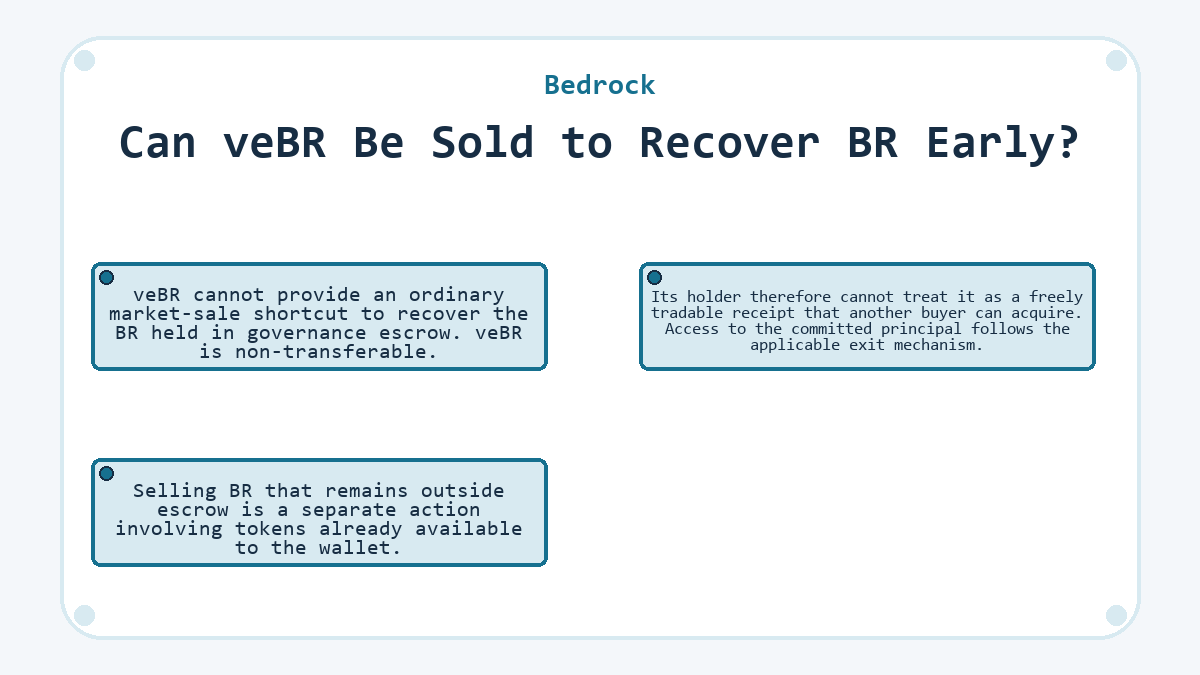
veBR cannot provide an ordinary market-sale shortcut to recover the BR held in governance escrow. veBR is non-transferable. Its holder therefore cannot treat it as a freely tradable receipt that another buyer can acquire. Access to the committed principal follows the applicable exit mechanism. Selling BR that remains outside escrow is a separate action involving tokens already available to the wallet.
A Queued Exit Reaching a Wallet Balance
A hypothetical BR holder wants to recover an existing veBR position's principal for a later transfer. The position's age and the transfer deadline are hypothetical. The holder needs the BR in the wallet before making the transfer.
Before submitting the exit, the holder checks that the position satisfies the minimum holding requirement and any applicable exit window. Assume those conditions are satisfied in this case. The request can then enter the exit mechanism; the upcoming transfer deadline cannot shorten its cooldown.
The accepted request produces a queued exit. The holder can see the queued position, but its BR remains unavailable for the planned transfer. The holder waits until the position meets the release condition and completes the supported withdrawal.
After completion, the returned BR appears in the holder's wallet. The observed token receipt matches the principal released by the withdrawal, accounting for any applicable exit charge. If only a pending queue entry remains, the intended wallet state has not been reached.
Reward Eligibility and Spendable Proceeds
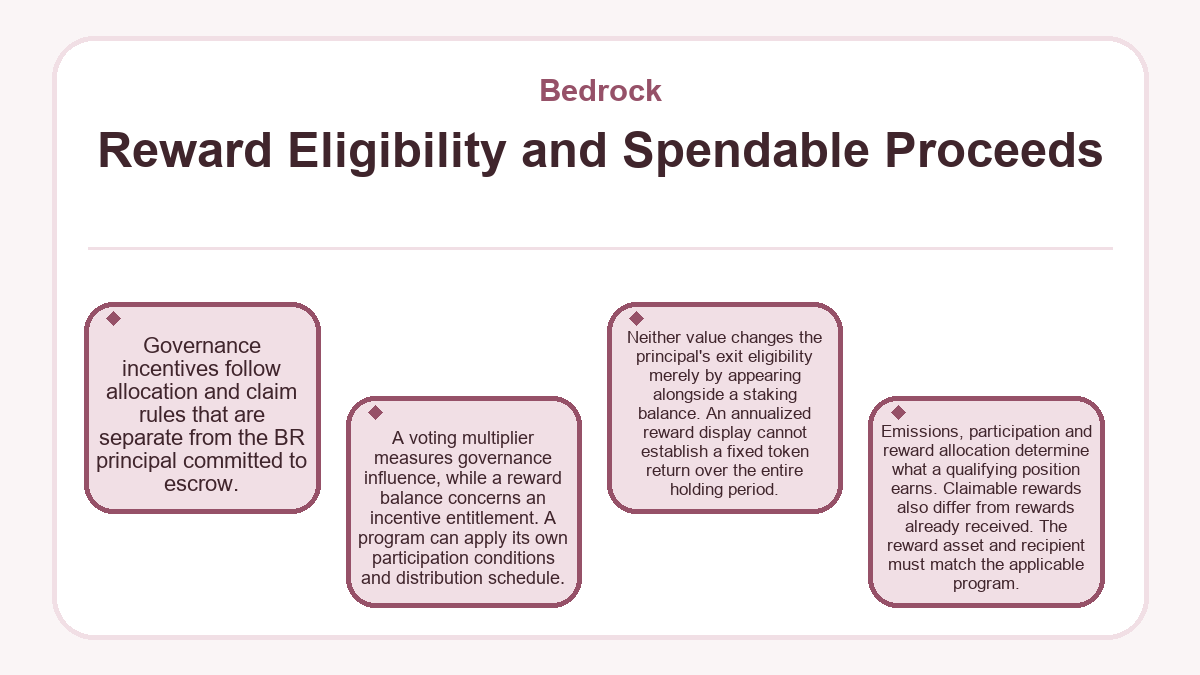
Governance incentives follow allocation and claim rules that are separate from the BR principal committed to escrow. A voting multiplier measures governance influence, while a reward balance concerns an incentive entitlement. A program can apply its own participation conditions and distribution schedule. Neither value changes the principal's exit eligibility merely by appearing alongside a staking balance.
An annualized reward display cannot establish a fixed token return over the entire holding period. Emissions, participation and reward allocation determine what a qualifying position earns. Claimable rewards also differ from rewards already received. The reward asset and recipient must match the applicable program.
Governance Controls and Seasonal Weight
Contract permissions govern changes to escrow settings, so owning veBR does not provide unilateral control over a position's withdrawal restrictions. The governance model includes adjustable deposit, timing and fee parameters. Its initial configuration involved team administration, with governance authority intended to develop over time. Participation rights and administrative permissions have different effects; a successful stake does not establish ownership of the contract's configuration controls.
Seasonal voting adjustments, where implemented, concern accumulated influence while the BR commitment remains governed by escrow. A weight reset is separate from principal withdrawal. It cannot be treated as an automatic release date. The active governance implementation determines the position's weight and any seasonal behavior, so continued staking should not be interpreted as an unlimited promise that influence will keep increasing indefinitely.
BR Liquidity Without Governance Escrow
Keeping BR in a wallet preserves transferability and avoids the withdrawal conditions attached to a veBR position. Trading that BR still requires a functioning market with sufficient liquidity for the intended transaction. A token's ability to move between addresses does not establish the price that a sale can achieve.
BR used in supported lending or liquidity arrangements follows those arrangements' own custody, withdrawal and market conditions. It should not be described as immediately available merely because it sits outside governance escrow. Holding BR directly retains the ability to transfer the wallet balance; locking it gives that committed amount governance weight while limiting access.
Good to know
-
Do uniETH or uniBTC Holdings Qualify Me to Vote With veBR?
- Holding uniETH or uniBTC does not replace the BR commitment required to obtain veBR. Those tokens represent asset staking or restaking positions. Governance voting power comes from BR deposited into the applicable escrow. Participation in an asset product or its incentives therefore does not, by itself, establish veBR voting eligibility.
-
Does Locking BR Permanently Remove It From the Token Supply?
- Locking BR holds tokens in escrow rather than permanently destroying the committed principal. It reduces the amount freely available for use while the commitment remains active. The underlying BR can return through the exit mechanism once its conditions are met. Locked supply and burned supply therefore describe different token states.
-
Can a veBR Position Be Split for a Partial Exit?
- Position splitting depends on whether that capability is enabled in the deployed escrow. Aragon's governance framework supports splitting as an optional feature, so availability cannot be assumed for every veBR position. A resulting position still has to satisfy its applicable exit conditions; splitting does not itself return BR to a wallet.
-
Which Costs Remain When the Protocol Exit Fee Is Zero?
- A zero protocol exit fee leaves network transaction charges separate from the withdrawal's fee setting. A wallet paying network gas directly needs the network's fee token to execute the relevant transactions. On BNB Chain, gas is paid in BNB. If returned BR is subsequently traded, the selected market can impose its own trading charges.
-
Will a New Stake Qualify for the Original soft-launch Emissions Allocation?
- The original soft-launch allocation applied to stakes made during that launch window. It was a one-time distribution, not a standing benefit for later deposits. A new position's incentives follow the eligibility and allocation terms of its applicable reward program. An old advertised launch return does not establish a reward entitlement for a later stake.
-
Are veBR Voting Records Private?
- On-chain veBR votes form public records associated with wallet addresses. The absence of a displayed real name does not hide an address's recorded voting activity. Connecting a wallet does not make its on-chain votes confidential.
-
Does Staking BR Give Me Ownership or Dividend Rights in Bedrock?
- Staking BR provides governance participation without granting corporate ownership or dividend rights. Its utility rights do not create an entitlement to protocol revenue. Reward-program allocations are distinct from equity distributions, and influence over a treasury proposal does not give a holder a personal share of treasury assets.
-
Can I Create veBR on Every Network Where BR Is Available?
- BR availability on a network does not establish a local veBR staking route. The documented governance contracts are deployed on BNB Chain, while BR has deployments on other networks. A governance deposit requires compatible BR on the network used by the selected escrow. A token listing alone does not establish that compatibility.
last updated